

For wholesalers and repair businesses, choosing the right supplier is one of the most important decisions when sourcing replacement phone screens. Many buyers compare different suppliers based only on price — focusing on the lowest unit cost without considering how the supplier's business model affects product consistency, supply stability, communication efficiency, and long-term business growth. However, supplier type matters just as much as supplier price, and understanding the difference between working with a manufacturer versus a trading intermediary can fundamentally change a buyer's procurement strategy.
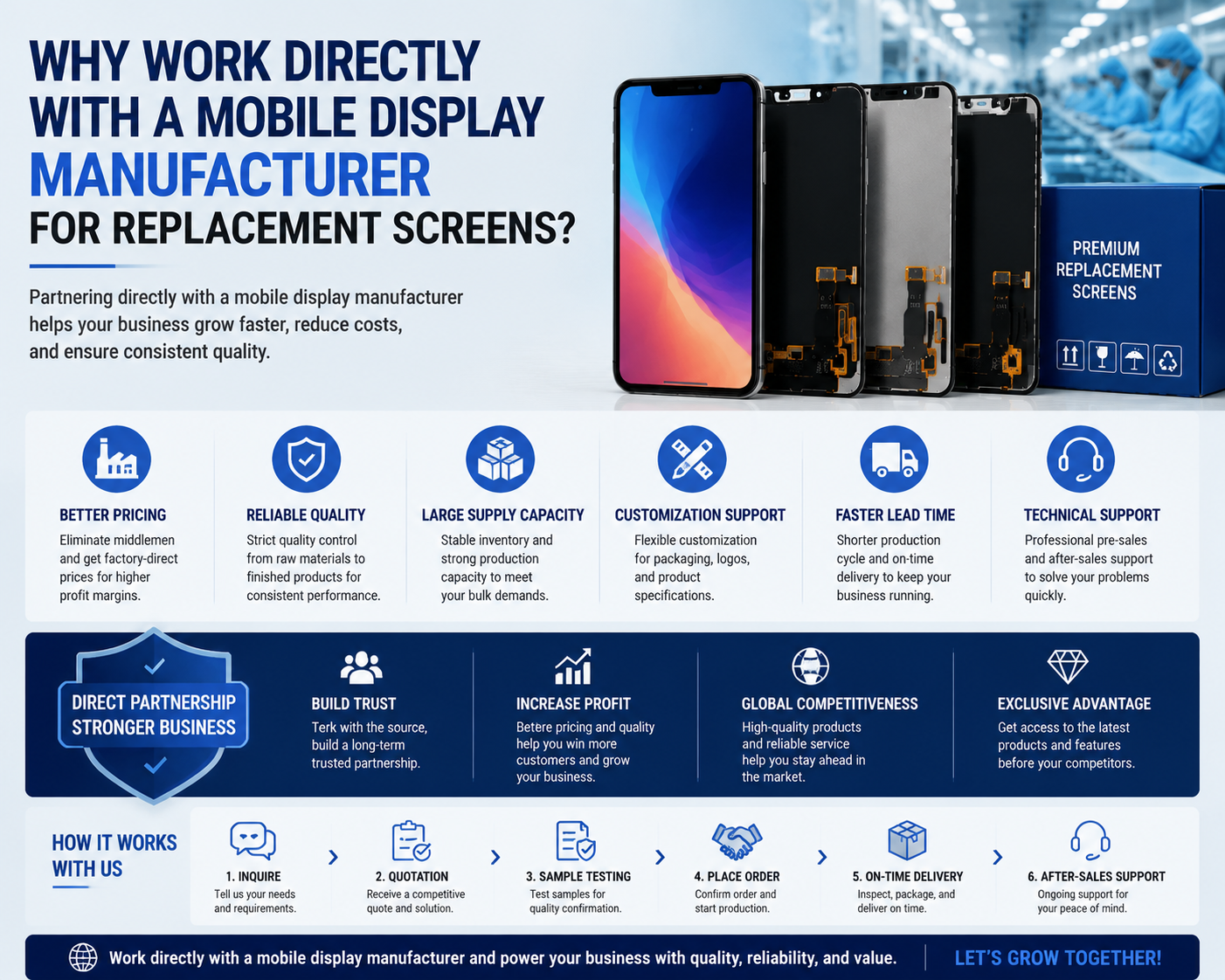
Working directly with a mobile display manufacturer can provide more advantages compared with purchasing through multiple intermediaries. Direct manufacturer relationships offer better cost control through fewer supply chain layers, more stable product quality through direct production oversight, faster technical support through immediate access to product expertise, and stronger long-term supply reliability through direct production planning. These benefits compound over time — making the choice of supplier type one of the most strategic decisions a growing B2B buyer can make.
This article explains why global buyers should consider partnering directly with a professional mobile display assembly manufacturer, compares manufacturer and trading company models, and provides practical criteria for evaluating manufacturing partners.
Manufacturer vs Trading Company: What Is the Difference?
The distinction between working with a manufacturer and a trading company is one of the most important concepts for buyers sourcing wholesale phone screens. Each model has different implications for pricing, quality control, technical support, and supply chain stability.
Working With a Trading Company
Trading companies serve as intermediaries between manufacturers and buyers, aggregating products from multiple sources to offer a broad catalog. This model offers certain advantages: easy product sourcing across multiple categories without dealing with multiple suppliers individually, and access to various replacement screen types from different factories. For buyers with small order volumes or diverse product needs, a trading company can simplify procurement by consolidating purchases into a single transaction.
However, the trading company model has inherent limitations that become more significant as order volumes grow and quality requirements increase. Because trading companies do not control production, they have less influence over product quality and consistency. When a quality issue arises, the trading company must relay information back through the supply chain — adding time and potential miscommunication to the resolution process. Technical knowledge is often secondhand, derived from manufacturer documentation rather than direct engineering experience. And each layer in the supply chain adds cost, meaning buyers ultimately pay for the intermediary's margin on top of the manufacturer's price.
Working Directly With a Mobile Display Manufacturer
A mobile phone screen supplier that operates its own manufacturing facilities offers a fundamentally different value proposition. Direct production control means the manufacturer can manage every stage of the process — from incoming material inspection through assembly testing to final quality verification. This control translates into more consistent product quality and greater flexibility to address buyer requirements.
Direct manufacturer relationships also provide deeper product knowledge. When a buyer has a technical question about screen compatibility, connector specifications, or installation requirements, a manufacturer can provide answers based on engineering expertise rather than relaying questions through the supply chain. This direct access to technical knowledge reduces communication delays and improves the accuracy of support. For bulk phone screen orders, where even small misunderstandings about specifications can result in costly returns, this direct technical communication is particularly valuable.
The following comparison highlights the key differences between purchasing from a manufacturer versus a trading company:
| Factor | Trading Company | Mobile Display Manufacturer |
|---|---|---|
| Production Control | No direct control over manufacturing | Full oversight of production, materials, and quality processes |
| Product Quality | Dependent on source factory; quality may vary between batches | Consistent quality through standardized production and testing |
| Technical Support | Secondhand knowledge, may require relay communication | Direct engineering expertise, faster problem resolution |
| Pricing | Includes intermediary markup at each supply chain layer | Direct pricing without intermediary margins |
| Customization | Limited — must relay requests through multiple parties | Direct customization of specs, packaging, and labeling |
| Supply Stability | Dependent on third-party factory schedules | Planned production, managed inventory, predictable lead times |
5 Benefits of Buying Replacement Screens Directly From Manufacturers
Partnering directly with a phone display manufacturer delivers advantages across every aspect of the procurement process — from initial pricing through ongoing supply management. These benefits compound over time, making the manufacturer relationship increasingly valuable as a buyer's business grows.
1. Better Cost Control
Removing intermediary layers from the supply chain directly reduces purchasing costs. When buyers purchase through a trading company, they pay the manufacturer's price plus the trading company's margin — and often the margins of multiple intermediaries in a multi-tier distribution network. A direct relationship with a replacement screen manufacturer eliminates these intermediate costs, delivering better LCD screen wholesale pricing for large distributors, repair chains, and high-volume buyers.
Importantly, this cost advantage comes from supply chain efficiency — not from sacrificing product quality. When a manufacturer reduces costs by optimizing production processes, improving yield rates, and managing material sourcing directly, the savings are structural and sustainable. This is fundamentally different from a trading company that achieves lower prices by sourcing from factories with lower quality standards. For B2B buyers focused on long-term business growth rather than short-term margin extraction, understanding this distinction is critical.
2. More Stable Product Quality
Quality stability is one of the most important concerns for phone repair parts supplier buyers. The real-world cost of inconsistent quality is enormous: a batch of screens with a 5% defect rate does not just mean 5% more cost — it means 5% of customers are disappointed, 5% of repairs require rework, and potentially far more than 5% of the original profit margin is consumed by handling returns, shipping replacements, and managing warranty claims.
A mobile display manufacturer can control quality at every stage: raw material selection, production process management, inline testing, and final quality inspection. This end-to-end control means the manufacturer can implement systematic phone screen quality inspection procedures that catch defects before they leave the factory. The result for buyers is a consistently lower defect rate, fewer customer returns, reduced rework costs, and greater confidence when placing large orders.
3. Stronger Product Customization Capability
For brand distributors, regional suppliers, and businesses that want to differentiate their offerings, customization capability is a significant competitive advantage. A direct manufacturer relationship enables customization that is simply not feasible through trading intermediaries, including product specification adjustments to meet specific market requirements, customized packaging with the buyer's brand identity, tailored labeling and documentation for import compliance, and special order configurations for unique market segments.
For example, a regional distributor may need screens in specific packaging formats with local-language labeling and compliance documentation for customs clearance. A replacement screen manufacturer can accommodate these requirements directly through production planning adjustments. A trading company, by contrast, would need to negotiate with an external factory — adding cost, time, and the risk of communication errors that result in incorrectly customized products.
4. Faster Communication and Technical Support
When a buyer has a technical question about LCD screen replacement compatibility, connector specifications, or installation procedures, the speed and accuracy of the response directly affects business operations. A manufacturer can provide answers based on firsthand production knowledge — the engineer who designed the screen, the quality technician who tested it, or the product manager who specified its components.
With a trading company, these technical questions must be relayed through the supply chain: the buyer asks the trader, the trader contacts the factory, the factory provides an answer, the trader relays it back to the buyer. Each handoff introduces the potential for miscommunication, delay, and incomplete information. For businesses that need to make quick decisions about inventory, pricing, or customer commitments, this indirect communication can become a serious operational bottleneck.
Direct communication with a manufacturer also enables more efficient order management. Questions about lead times, production schedules, and shipping arrangements can be answered immediately — without waiting for a trading intermediary to coordinate with their upstream suppliers.
5. More Reliable Long-Term Supply
For B2B buyers building long-term businesses, supply reliability is often more important than the lowest possible unit price. An OLED display supplier with its own manufacturing operation can plan production based on direct customer demand, maintain safety stock for popular models, and provide predictable lead times that enable better inventory planning. Over months and years of cooperation, this reliability translates into fewer stockouts, more consistent customer service, and lower business risk.
A manufacturer partnership also provides better product lifecycle support. When smartphone manufacturers release new models, a smartphone display manufacturer can develop replacement screen solutions quickly — giving their B2B customers early access to new-model inventory. Similarly, when older models phase out, a manufacturer can provide clear end-of-life notifications and last-time-buy opportunities, enabling buyers to plan their inventory transitions smoothly.
What Should Buyers Look for in a Mobile Display Manufacturer?
Not all manufacturers offer the same value, and selecting the right partner requires evaluating factors beyond price and catalog size. The following criteria help buyers identify a mobile display manufacturer that can serve as a reliable long-term partner rather than just another supplier:
Wide Product Coverage
A professional phone display manufacturer should maintain broad product coverage across multiple smartphone brands and models. This coverage should include both LCD replacement screens for cost-sensitive repair markets and budget-friendly device models, and OLED touch screen assemblies for premium smartphone repairs where customers expect near-original display quality. The manufacturer's catalog should span popular brands demanded by repair businesses and distributors worldwide:
- Huawei — Mate, Nova, and Honor series displays
- OPPO — Reno, A-series, and Find X series screens
- Vivo — V-series, Y-series, and S-series assemblies
- Xiaomi — Mi, Redmi Note, and Poco series display parts
- Redmi — Note series and K series replacement screens
- OnePlus — LCD and OLED display assemblies for flagship and Nord series devices
Quality Control Capability
Quality control is the foundation of a reliable manufacturing partnership. Buyers should evaluate whether the manufacturer has systematic processes for display testing (resolution, brightness, color accuracy, and dead pixel inspection), touch testing (sensitivity, multi-touch, and touch alignment verification), appearance inspection (glass surface, frame fitment, and connector integrity), and compatibility testing across target phone models. These quality gates should be documented, standardized, and applied consistently — not dependent on the diligence of individual workers or the urgency of production schedules.
A manufacturer that can demonstrate its replacement phone screen quality control processes — including sampling rates, defect thresholds, and corrective action procedures — provides transparency that builds buyer confidence. Ask about defect rate data, return rate statistics, and how quality issues are traced back to their root cause and corrected in the production process.
Production and Supply Capability
Manufacturing experience and production capacity directly affect a supplier's ability to serve B2B customers reliably. Key indicators include how long the manufacturer has been producing LCD assembly products for the mobile phone market, their monthly production capacity and ability to scale for large orders, their track record for on-time delivery and order fulfillment, and their production planning and inventory management systems.
For wholesale buyers placing large bulk phone screen orders, production stability is as important as product quality. A manufacturer that can consistently produce thousands of screens per month with uniform quality is fundamentally different from one that handles small batches with variable results.
Professional B2B Support
Beyond manufacturing capability, professional B2B support distinguishes a true partner from a transactional supplier. Manufacturers that serve the B2B wholesale and repair market should provide technical assistance for compatibility questions, product selection guidance, and installation support; bulk order management with clear pricing tiers, lead time estimates, and order status visibility; responsive after-sales service including warranty handling, defect resolution procedures, and replacement shipping; and account management that understands the buyer's business needs and market conditions.
Why Direct Manufacturer Partnerships Matter for Growing Repair Businesses
For repair businesses and distributors planning long-term growth, the supplier relationship evolves from a purchasing transaction into a strategic partnership. A direct relationship with a mobile display manufacturer helps businesses reduce purchasing risks through predictable quality and supply, improve repair efficiency with consistent and compatible products, expand product categories as the manufacturer adds new models and technologies, and increase profit margins through better pricing, fewer warranty claims, and more efficient operations.
This partnership model is particularly valuable for repair chains opening new locations, regional distributors expanding into new territories, and refurbishment companies scaling their processing volumes. In each case, the reliability and consistency provided by a direct manufacturer relationship enables predictable growth — the business can forecast costs accurately, commit to customer delivery timelines confidently, and invest in expansion without worrying about supply chain disruptions.
Mobile Display Solutions Provided by STMAX
STMAX specializes in mobile display solutions for global wholesale distributors, repair businesses, and refurbishment companies. As a mobile display manufacturer with direct production capability, we provide mobile phone LCD replacement screens, OLED display assemblies, and touch screen assemblies — all manufactured under systematic quality control from incoming material inspection through production testing to final shipment verification.
Our replacement screen solutions support popular smartphone brands demanded by repair businesses and distributors worldwide:
- Huawei — Mate series, Nova series, and Honor model displays
- OPPO — Reno series, A-series, Find X series LCD and OLED assemblies
- Vivo — V-series, Y-series, S-series screen replacements
- Xiaomi — Mi series, Redmi Note series, Poco series display assemblies
- Redmi — Note series, K series with LCD and AMOLED options
- OnePlus — LCD and OLED display assemblies for flagship and Nord series models
Whether you need LCD replacement screens for cost-sensitive repair markets or OLED assemblies for premium smartphone repairs, STMAX delivers consistent quality through direct manufacturing control. Our commitment to systematic quality management, reliable supply, and professional B2B support makes us more than a supplier — we are a long-term partner for businesses building their future in the mobile phone repair and distribution industry.
Browse our product catalog to explore our complete range of replacement displays, or contact us to discuss your direct procurement requirements with our team.
Frequently Asked Questions
What is a mobile display manufacturer?
A mobile display manufacturer is a company that produces replacement display components — including LCD screens, OLED assemblies, and touch screen modules — for the smartphone repair and distribution markets. Unlike trading companies that source products from third-party factories, a manufacturer operates its own production facilities, manages its own quality control processes, and controls the entire production workflow from material sourcing through final inspection. This direct control enables manufacturers to offer more consistent product quality and more responsive technical support to B2B buyers.
Why should businesses buy replacement screens directly from manufacturers?
Purchasing directly from manufacturers provides several structural advantages over buying through trading intermediaries. Direct relationships deliver better cost control by eliminating intermediary markups at each supply chain layer, more stable product quality through direct production oversight and standardized testing, faster and more accurate technical support based on firsthand engineering knowledge, and more reliable long-term supply through planned production and managed inventory. These benefits become increasingly significant as order volumes grow and quality requirements become more demanding.
How do I choose a reliable phone display manufacturer?
Selecting a reliable phone display manufacturer requires evaluating four key dimensions: product coverage across multiple smartphone brands and both LCD and OLED technologies, quality control capability demonstrated through systematic inspection processes and transparent defect rate data, manufacturing experience and production capacity to handle your order volumes consistently, and professional B2B support including technical assistance, responsive communication, and reliable after-sales service. Requesting samples and testing them against your quality requirements is an essential step before committing to a large-scale partnership.
Can mobile display manufacturers support wholesale orders?
Yes — professional mobile display manufacturers typically provide bulk supply solutions designed specifically for wholesale distributors, repair chains, refurbishment companies, and international buyers. Manufacturer-direct wholesale purchasing typically includes tiered pricing based on order volume, flexible order configurations based on the buyer's product mix requirements, planned production scheduling to ensure timely delivery, and ongoing supply support for repeat orders. The key advantage of manufacturer-direct wholesale is that the cost savings come from supply chain efficiency rather than quality compromises.
Looking for a reliable mobile display manufacturer for your wholesale replacement screen business?
STMAX provides LCD, OLED, and touch screen solutions for global distributors and repair companies.
View Products Contact STMAX