

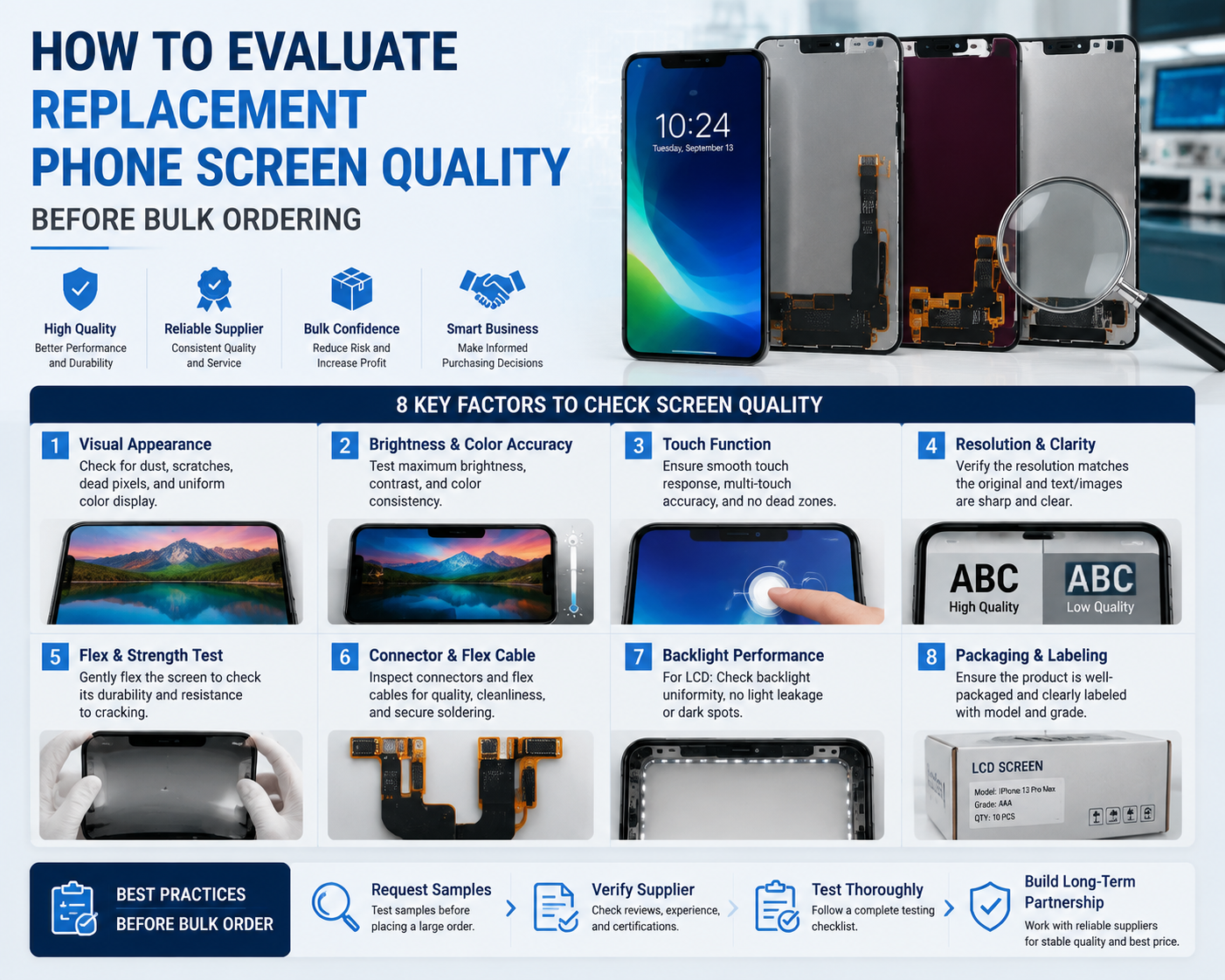
How to Evaluate Replacement Phone Screen Quality Before Bulk Ordering
For wholesalers and repair businesses, purchasing replacement phone screens in bulk involves significant investment — a single order can represent thousands of dollars and weeks of inventory. However, appearance alone cannot determine screen quality. Two screens that look identical at first glance can perform very differently once installed, tested, and used by customers over time. The gap between a quality product and a substandard one often only becomes visible after the return requests start coming in.
Low-quality replacement screens may cause a cascade of problems: touch failures that frustrate end users, display problems such as uneven brightness or color shifting, high return rates that wipe out profit margins, and customer complaints that damage a business's reputation. For B2B buyers, these problems are amplified — a single defective batch can affect dozens or hundreds of downstream customers simultaneously. This is why replacement phone screen quality evaluation before placing large orders is not optional; it is a critical business practice.
This guide explains the key quality factors buyers should check when sourcing LCD and OLED replacement screens, from display performance and touch testing to compatibility verification and supplier quality systems. Whether you are a wholesale phone screen distributor, a repair chain operator, or a refurbishment company, understanding how to evaluate screen quality before committing to bulk orders protects your investment and your reputation.
Why Replacement Screen Quality Matters for Wholesale Buyers
For B2B buyers, screen quality is not just a technical concern — it is a financial one. Every defective screen that reaches an end customer represents a chain of costs: the cost of the screen itself, the labor cost of installation, the shipping cost of returns, and the intangible cost of a damaged business relationship. When multiplied across bulk order volumes, even small quality gaps become significant.
Poor Quality Increases Business Costs
The true cost of a low-quality replacement screen extends far beyond its purchase price. When a screen fails after installation, the repair business absorbs the labor cost of a second repair, the cost of a replacement unit, and the shipping involved in warranty returns. In many cases, the total cost of dealing with a single defective screen can exceed the profit from three or four successful repairs combined.
Beyond direct costs, poor quality also creates indirect financial damage. Repair shops that install unreliable phone display parts face customer dissatisfaction that leads to negative reviews, lost repeat business, and a damaged reputation that can take years to rebuild. For wholesale distributors supplying screens to multiple repair shops, a quality issue in a single batch can damage relationships with an entire network of customers — making the financial impact exponentially larger than the cost of the screens themselves.
Consistent Quality Builds Customer Trust
Repair businesses and wholesale buyers depend on predictability. They need to know that each smartphone display screen they order will perform consistently — with stable brightness, reliable touch response, and accurate color reproduction across every unit. Inconsistent quality forces technicians to spend extra time testing and adjusting each screen before installation, slowing down repair throughput and reducing overall efficiency.
Consistent quality also enables businesses to set reliable pricing, offer meaningful warranties to their own customers, and build long-term relationships based on trust. When a repair shop knows that 99 out of 100 screens from a particular replacement screen supplier will work perfectly, they can quote prices and turnaround times with confidence — a competitive advantage in markets where customers value both speed and reliability.
Key Factors to Evaluate Replacement Phone Screen Quality
Evaluating replacement phone screen quality requires a systematic approach that goes beyond a quick visual check. Professional buyers and repair businesses should assess five key dimensions: display performance, touch response, physical construction, compatibility, and durability. Each dimension reveals different potential issues that can affect the end-user experience and the repair business's profitability.
1. Display Performance Testing
Display quality is the most visible indicator of phone screen quality inspection results. A screen that looks acceptable in isolation may reveal problems when compared side by side with a known good reference or tested under different lighting conditions. Key display performance factors include:
- Resolution and Image Clarity — Test screens by displaying high-resolution images, text at various sizes, and graphic content that reveals pixel-level issues. Look for sharpness across the entire display area, consistent pixel performance without ghosting, and text readability at small font sizes. A screen with substandard resolution may appear acceptable at a glance but cause eye strain during prolonged use.
- Brightness and Backlight Uniformity — Display a pure white image at maximum brightness and check for consistent illumination across the entire screen surface. Uneven backlighting appears as dark patches, bright spots, or a visible gradient — particularly along screen edges. Test at multiple brightness levels, as some screens show acceptable performance at 100% brightness but reveal unevenness at lower settings commonly used in indoor environments.
- Color Accuracy and Reproduction — Compare the screen against a calibrated reference or a known original display. Look for color shifting toward blue or yellow tones, oversaturation that makes images look unnatural, or washed-out colors that indicate poor panel quality. For LCD screen quality evaluation, pay particular attention to black levels and viewing angles — LCD panels with poor black reproduction can appear grayish in low-light conditions.
- Dead Pixels and Display Defects — Inspect the screen using solid red, green, blue, black, and white test images. This makes dead pixels, bright spots, dark spots, and screen lines immediately visible. Even a single dead pixel in a prominent location can make a screen unacceptable to end customers, especially for premium smartphone models where buyers expect flawless displays.
2. Touch Screen Performance Testing
Touch screen performance directly affects the end-user experience after a repair is completed. A display that looks perfect but has touch issues will generate immediate complaints and return requests. For LCD touch assemblies and mobile display assembly products, systematic touch testing is essential before approving bulk orders:
- Touch Sensitivity — Test that the screen responds immediately to light touches without requiring excessive pressure. Swipe, tap, and long-press across the entire display surface. Delayed response or the need for firmer taps than expected indicates a digitizer issue that will frustrate end users and generate warranty claims. For OLED screen quality assemblies, test edge sensitivity carefully — curved or edge-to-edge displays should register touches consistently across all areas.
- Multi-Touch Functionality — Verify multi-touch by using gestures like pinch-to-zoom, two-finger rotation, and simultaneous multi-point touches. Many smartphone applications rely on multi-touch for core functionality, and a screen that cannot track multiple touch points accurately will be rejected by end users. Test on a drawing or note-taking application to check whether all touch points are tracked simultaneously without cross-talk or ghost touches.
- Touch Alignment and Accuracy — Draw lines and write text across the display to check whether touch input aligns precisely with the on-screen position. Misalignment — where touches register slightly offset from where the user's finger actually contacts the screen — is a common issue in lower-quality replacement screens. Pay special attention to the screen edges and corners, where alignment problems are most likely to occur.
3. Physical Quality and Assembly Inspection
A replacement screen is more than just a display panel — it is a complete assembly that includes the glass surface, frame, connectors, and mounting structure. Physical quality issues can prevent proper installation or cause the screen to fail weeks or months after the repair is completed.
- Glass Surface Quality — Inspect the glass under bright light for scratches, micro-abrasions, uneven oleophobic coating, or surface imperfections that are not immediately visible. Run a finger across the surface to feel for roughness or inconsistent texture. High-quality LCD screen wholesale products should have smooth, clean glass surfaces with uniform coating.
- Frame and Housing Fitting — Check that the metal or plastic frame is properly aligned, without gaps, warping, or sharp edges. The frame should match the original dimensions precisely — even a 0.5mm discrepancy can prevent proper installation or create visible light leakage around the edges.
- Connector and Flex Cable Condition — Examine the flex cables and connectors for damage, proper alignment, and sufficient length. Bent or poorly soldered connectors are a common failure point that can cause intermittent display issues or complete screen failure after installation.
- Assembly Accuracy — Verify that the LCD panel, touch digitizer, glass, and frame are properly bonded together. Bubbles between layers, visible adhesive residue, or misaligned layers indicate poor assembly quality that will lead to long-term reliability problems.
4. Compatibility Testing
Before placing bulk phone screen orders, buyers must confirm that each screen model is fully compatible with the target phone model. Compatibility issues are among the most common and costly problems in wholesale replacement screens purchasing — a screen that fits one variant of a phone model may not work with another variant that uses a different display controller or connector layout.
Compatibility verification should cover the complete screen assembly, including the phone model and specific variant (regional variants may use different display hardware), the screen size and aspect ratio matching the original specification, the connector type and pin configuration, and the assembly design including frame shape and mounting points. For buyers serving diverse markets, a mobile phone display supplier should provide detailed compatibility documentation for brands including:
- Huawei — Mate, Nova, and Honor series with region-specific display variants
- OPPO — Reno, A-series, and Find X models with LCD and OLED options
- Vivo — V-series, Y-series, and S-series smartphone displays
- Xiaomi — Mi, Redmi Note, and Poco series replacement screens
- Redmi — Note series, K series with LCD and AMOLED assemblies
- OnePlus — Flagship and Nord series with LCD and OLED display options
5. Durability and Reliability Testing
While most pre-purchase quality checks focus on immediate performance, long-term reliability is equally important for maintaining customer satisfaction. Professional phone screen quality inspection should include basic durability assessments that predict how the screen will perform over weeks and months of daily use:
- Continuous Operation Testing — Run the screen continuously for several hours to identify issues that only appear after extended use, such as image retention (temporary ghosting of static elements), gradual brightness drift, or touch response degradation as the digitizer warms up.
- Touch Durability — Perform repeated touch operations on the same screen areas to simulate weeks of typical use. Screens with low-quality digitizer films can show degraded touch sensitivity or dead spots after extended activation of the same touch zones — a problem that only becomes apparent after the screen has been in use for some time.
- Temperature Resistance — Test screen performance after exposure to moderate temperature variations. Smartphones are frequently used outdoors, in vehicles, and in other environments where temperature can affect display performance. A quality replacement screen should maintain stable brightness, color, and touch response across reasonable temperature ranges.
How Professional Suppliers Control Replacement Screen Quality
Understanding a supplier's quality control process is essential for buyers evaluating replacement phone screen quality. Professional phone repair parts supplier operations implement systematic quality control at multiple stages — not just a final inspection before shipment. The presence and rigor of these quality gates directly affect the consistency and reliability of the screens that buyers receive.
Incoming Material Inspection
Quality control begins before production starts. Professional suppliers inspect incoming display components, touch panels, and glass materials for defects that would carry through to the finished product. Raw LCD panels are checked for pixel defects and color uniformity. Touch digitizer films and glass layers are inspected for surface quality and dimensional accuracy. Component-level inspections prevent defective materials from entering the production line — a far more efficient approach than trying to catch assembly-level defects later.
Production Testing
During assembly, quality-oriented suppliers perform inline testing at key production stages. Display testing verifies that each panel exhibits correct resolution, brightness, and color performance after the LCD-to-glass bonding process. Touch testing confirms digitizer sensitivity and multi-touch capability after the touch layer integration. Assembly inspection checks the physical alignment of the frame, glass, and display layers, as well as connector integrity and fitment accuracy. These inline checks catch defects immediately — before additional value is added to a faulty unit — minimizing waste and ensuring that only correctly assembled screens proceed to final inspection.
Final Quality Inspection Before Shipment
The final quality gate combines appearance inspection, functional testing, and packaging verification. Each screen undergoes a systematic visual check under controlled lighting for scratches, dust between layers, frame alignment, and connector condition. Functional testing covers display performance across multiple test patterns, touch response and multi-touch tracking, and basic operational checks in a test device or fixture. Packaging inspection ensures that each screen is properly protected with the correct electrostatic discharge (ESD) packaging and adequate cushioning to survive international shipping without damage.
Sample Testing Before Bulk Replacement Screen Orders
Even with a supplier's quality certifications and test reports, hands-on sample testing is the only way to verify replacement phone screen quality for your specific needs. A structured sample evaluation process protects buyers from committing to large orders with unproven products. Here is a practical three-step approach:
Step 1: Order Samples Strategically
Do not test just one screen model. Order samples that represent the range of products you plan to purchase — popular models that will form the bulk of your orders, different product types such as both LCD and OLED screens, and models from multiple phone brands to verify the supplier's quality consistency across their catalog. Testing a diverse sample set reveals whether the supplier maintains consistent quality across their entire product range, or only on a few high-volume items.
Step 2: Test Real Repair Performance
Install sample screens in actual devices rather than relying solely on bench testing. Real installation reveals compatibility issues — such as connector alignment problems, frame fitting discrepancies, or assembly challenges — that may not be apparent during isolated testing. After installation, evaluate the screen's performance as an end user would: check display quality in different lighting conditions, test touch responsiveness during everyday tasks, and verify that all device functions that depend on the screen work correctly. For replacement screen comparison purposes, consider testing samples from multiple suppliers side by side in identical phone models.
Step 3: Confirm Supplier Quality Before Scaling Orders
Before scaling from samples to bulk phone screen orders, confirm that the supplier can maintain the same quality level at production volume. Ask about their quality consistency track record — what percentage of screens pass final inspection, and how does the supplier handle units that do not meet quality standards? Verify their delivery capability for your required order volumes and shipping timelines. Clarify their after-sales support process — what happens if a defect is discovered after delivery, and how quickly can replacement units be shipped?
Common Quality Problems in Replacement Phone Screens
Experienced buyers learn to recognize the quality issues that most commonly affect wholesale replacement screens. Understanding these problems helps buyers communicate requirements clearly to suppliers and conduct more effective incoming quality inspections. The most frequent quality problems fall into three categories:
| Problem Category | Common Issues | Impact on Business |
|---|---|---|
| Display Issues | Color difference from original, low brightness, screen flickering, uneven backlight, dead pixels | Customer complaints, warranty returns, reduced repair pricing for lower-quality work |
| Touch Problems | Slow touch response, dead touch areas along edges, multi-touch failure, ghost touches | Unusable device after repair, immediate return, technician rework time |
| Installation Problems | Poor frame fitting, connector incompatibility or damage, screen lifting after installation | Increased installation time, damaged connectors on customer devices, repeat repairs |
These issues share a common characteristic: they are all detectable through proper quality inspection before bulk ordering, but become far more expensive to resolve after screens have been shipped, installed, and delivered to end customers. Investing time in quality evaluation upfront — through sample testing, supplier audits, and systematic inspection — is always more cost-effective than managing the consequences of quality failures downstream.
Why Choose STMAX for Quality Replacement Screens
STMAX provides quality-tested replacement screens for global distributors, repair businesses, and wholesale buyers. Our product range covers LCD replacement screens for cost-effective repair markets, OLED touch screen assemblies for premium smartphone repairs, and complete smartphone display solutions designed for the B2B wholesale and repair industry. Every screen undergoes systematic quality inspection covering display performance, touch response, physical assembly, and compatibility verification before shipment.
Our product lineup supports popular smartphone brands and models demanded by repair businesses worldwide:
- Huawei — Mate series, Nova series, and Honor replacement displays
- OPPO — Reno series, A-series, Find X series LCD and OLED assemblies
- Vivo — V-series, Y-series, S-series screen replacements
- Xiaomi — Mi series, Redmi Note series, Poco series display assemblies
- Redmi — Note series, K series with LCD and AMOLED options
- OnePlus — LCD and OLED display assemblies for flagship and Nord series models
Whether you are a wholesale phone screen distributor purchasing by the container load, a regional repair chain standardizing on a single supplier, or a refurbishment company processing thousands of devices, STMAX's commitment to stable product quality, professional display solutions, and long-term supply cooperation makes us the reliable partner your business needs. Our quality control system — from incoming material inspection through production testing to final shipment verification — ensures that every batch meets the consistency standards that professional buyers demand.
Explore our full product catalog to see the complete range of replacement screens, or contact us to request samples and discuss your quality requirements before placing a bulk order.
Frequently Asked Questions
How can I test replacement phone screen quality before bulk purchasing?
Before committing to a bulk order, you should conduct a structured evaluation covering five areas: display performance testing (resolution, brightness, color accuracy, and dead pixel inspection), touch screen performance testing (sensitivity, multi-touch, and touch alignment), physical quality inspection (glass surface, frame fitting, connectors, and assembly accuracy), compatibility testing across target phone models, and basic durability testing for long-term reliability. Testing sample screens from multiple suppliers side by side in identical phone models provides the most useful comparison data for making an informed purchasing decision.
What are common problems with low-quality replacement screens?
The most frequent problems with low-quality replacement screens include display issues such as color differences from the original screen, uneven brightness, backlight flickering, and dead or stuck pixels; touch problems including slow response, unresponsive areas (particularly along screen edges), and multi-touch failure; and installation problems caused by poor frame fitting, incompatible or damaged connectors, and screens that begin lifting from the phone frame shortly after installation. Any of these issues leads to customer returns, technician rework time, and damage to the repair business's reputation.
Should buyers test samples before placing large orders?
Yes — sample testing is a critical step before placing large replacement screen orders. Samples allow buyers to verify display quality, touch performance, physical assembly quality, and compatibility with target phone models under real installation and usage conditions. Testing samples also reveals whether the supplier maintains consistent quality across different phone models, which is essential for buyers who plan to purchase screens for multiple brands. Leading professional buyers order samples representing both popular models and different product types (LCD and OLED) to evaluate the supplier's quality consistency before scaling to bulk order volumes.
What makes a reliable replacement screen supplier?
A reliable replacement screen supplier should demonstrate consistent product quality through systematic quality control at multiple production stages — incoming material inspection, inline production testing, and final inspection before shipment. Beyond quality control, buyers should evaluate product compatibility coverage across multiple phone brands and models, competitive and stable pricing, reliable supply and inventory availability, responsive after-sales support and warranty handling, and a track record of maintaining quality consistency across large order volumes. The combination of quality systems and supply reliability is what distinguishes a long-term partner from a transactional vendor.
Looking for quality-tested replacement phone screens for your wholesale business?
STMAX provides reliable LCD and OLED display solutions for global repair companies and distributors.
Product Catalog Contact Us