

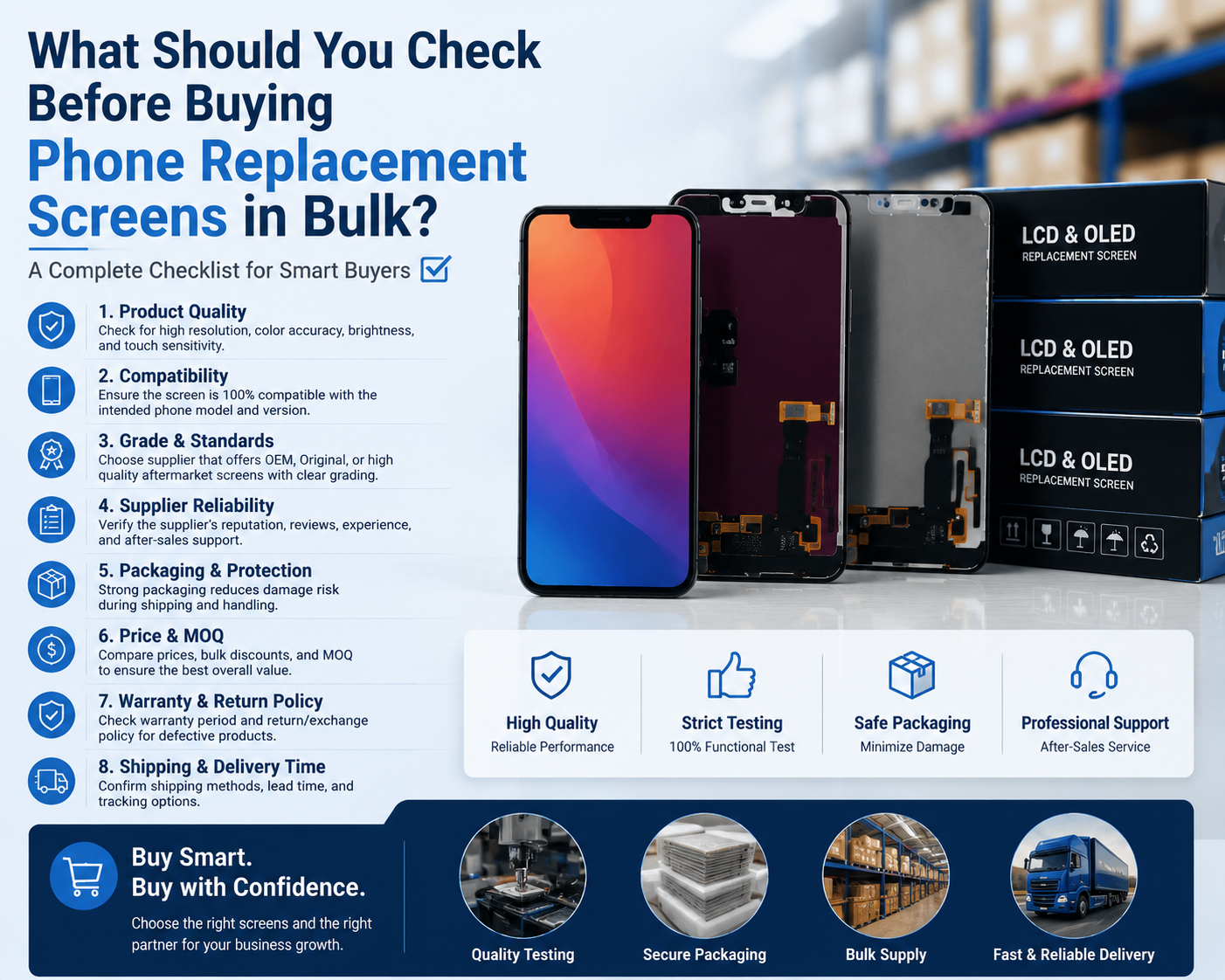
For mobile phone repair businesses and parts distributors, buying phone replacement screens in bulk can significantly reduce costs and improve supply stability. However, ordering large quantities without proper evaluation may lead to high defect rates, customer complaints, inventory problems, and financial losses.
Before placing a bulk order, buyers should carefully evaluate product quality, supplier capability, and compatibility to minimize purchasing risk. Whether you are a phone repair parts supplier stocking up on popular models or a wholesale mobile phone parts distributor building long-term inventory, a systematic evaluation process is essential.
This guide explains the key factors to check before purchasing wholesale replacement phone screens — helping you build a reliable procurement checklist and avoid costly mistakes.
Why Bulk Purchasing Replacement Phone Screens Requires Careful Evaluation
When you buy phone replacement screens in bulk, the stakes are higher than with single-unit purchases. Understanding the risks helps explain why a thorough evaluation process is critical.
Large Inventory Investment
Bulk orders mean more capital is tied up in inventory. If the products have quality issues, the financial impact is amplified — you may be left with unsellable stock and no easy way to recover your investment. This is why working with a trusted mobile phone screen supplier matters from the very first order.
Quality Problems Affect Repair Businesses
Low-quality screens can cause touch failure, display issues, and customer returns. For repair businesses, each defective screen means lost time, lost revenue, and potential damage to your reputation. A single bad batch can undo months of customer trust.
Compatibility Issues Increase Costs
Ordering the wrong model or specification can lead to unsellable inventory, return shipping costs, and delayed repairs. Compatibility verification is especially important when sourcing bulk phone replacement screens across multiple brands and models.
Check 1: Verify Phone Model Compatibility
Compatibility is the first and most critical check before any bulk purchase. Ordering screens that do not fit the target devices will result in unsellable inventory and return costs.
Before placing an order, confirm the following specifications:
- Phone brand — Huawei, OPPO, Vivo, Xiaomi, Redmi, OnePlus, etc.
- Model number — exact device model (e.g., Vivo V23 5G, not just "Vivo V-series")
- Screen size — measured diagonally in inches
- Connector type — flex cable must match the device motherboard
- Assembly structure — frame design and mounting points
Professional replacement screen suppliers should provide accurate product specifications and compatibility information. For example, STMAX provides clearly labeled products such as the Huawei Mate60 LCD assembly and Xiaomi Mi11t LCD assembly — each with detailed model compatibility information.
If you are unsure about which screen type fits your target devices, our LCD vs OLED replacement screens comparison can help you determine the correct display technology for each model.
Check 2: Evaluate Replacement Screen Display Quality
Display quality directly affects customer satisfaction and repair success rates. When evaluating wholesale replacement phone screens, focus on three key areas of phone screen quality inspection:
Resolution and Image Clarity
The replacement screen must match the original display resolution. Lower resolution screens produce blurry images and pixelation that customers will immediately notice. Check:
- Resolution — pixel count must match original specifications
- Pixel quality — no dead or stuck pixels in the display area
- Sharpness — text and images should be crisp and clear
Brightness and Color Performance
Inconsistent brightness or color reproduction is a common issue with low-quality replacement screens. Verify:
- Brightness consistency — screen should reach the same brightness level as the original
- Color accuracy — colors should match the original display without oversaturation or color shift
- Contrast performance — dark and light areas should be clearly distinguishable
Dead Pixels and Display Defects
Before accepting a bulk shipment, test samples for common display defects:
- Dead pixels — pixels that remain black or do not illuminate
- Light spots — uneven backlighting causing bright patches
- Screen abnormalities — color banding, flickering, or image persistence
For more details on display technology differences, read our mobile phone screen technology guide.
Check 3: Test Touch Screen Performance
For touch screen assemblies, touch performance is just as important as display quality. A screen with perfect visuals but poor touch response will still result in customer complaints and returns.
Touch Sensitivity
The touch layer must respond instantly to user input. Test for:
- Fast response — minimal lag between touch and screen reaction
- Accurate touch recognition — touch points should register precisely where the finger contacts the screen
Multi-Touch Function
Modern smartphones require reliable multi-touch support. Verify:
- Multiple touch points — screen should register 5+ simultaneous touches
- Smooth operation — pinch-to-zoom, swipe, and rotate gestures should work without stuttering
Glass and Surface Quality
The glass surface affects both durability and user experience:
- Scratches — no visible scratches or marks on the glass surface
- Fingerprint resistance — oleophobic coating should prevent excessive fingerprint buildup
- Surface defects — no bubbles, gaps, or uneven edges in the glass
STMAX touch screen assemblies, such as the Vivo Y200 LCD touch screen assembly and OPPO Reno 8 LCD touch assembly, undergo rigorous touch testing before shipment.
Check 4: Understand Supplier Quality Control Process
A reliable replacement screen supplier should have a transparent quality control process. Before committing to a bulk order, ask the supplier about their testing procedures.
Product Testing Before Shipment
Every screen should pass through a testing process before it leaves the factory. A reliable supplier should perform:
- Display testing — verify image output, brightness, and color accuracy
- Touch testing — confirm touch sensitivity and multi-touch functionality
- Appearance inspection — check for scratches, dead pixels, and assembly defects
- Functional testing — full end-to-end test to ensure the screen works with the target device
Defect Rate Management
For bulk orders, quality consistency is critical. Discuss the following with your supplier:
- Quality consistency — what is the expected defect rate per batch?
- Replacement policy — how does the supplier handle defective units?
- After-sales support — is there a warranty period and return process?
For more guidance on evaluating suppliers, see our articles on choosing a reliable screen supplier and wholesale LCD screen buying strategies.
Check 5: Review Supplier Production and Supply Capability
For long-term partnerships, you need a supplier who can consistently meet your demand. Evaluate their production capacity and supply stability before committing to large orders.
Product Availability
A reliable supplier should maintain adequate stock of popular models and have a clear production schedule. Check:
- Popular model inventory — are high-demand models like the Redmi Note 12 LCD assembly or Xiaomi K40 LCD assembly consistently in stock?
- Production schedule — can the supplier meet your lead time requirements for restocking?
Manufacturing Experience
Experience matters in display manufacturing. Evaluate the supplier's:
- Industry experience — how long have they been manufacturing replacement screens?
- Product range — do they cover multiple brands and models?
- Technical capability — can they provide both LCD and OLED solutions?
Communication Support
Good communication is essential for smooth bulk purchasing. The supplier should offer:
- Fast response — timely replies to inquiries and order updates
- Technical assistance — support for compatibility questions and technical issues
- Order tracking — visibility into production and shipping status
Check 6: Review Packaging and Shipping Solutions
Mobile phone screens are fragile products that require careful handling during transportation. Even high-quality screens can be damaged in transit if packaging is inadequate.
Confirm that your supplier provides:
- Protective packaging — shock-absorbing materials to prevent impact damage
- Individual packaging — each screen should be packaged separately to prevent screen-to-screen contact
- Safe shipping methods — reliable logistics partners with tracking capability
- Anti-static protection — anti-static bags or materials to protect electronic components
Proper packaging reduces transportation damage and replacement costs — an often-overlooked factor that can significantly impact your total cost of ownership when you buy phone replacement screens in bulk. For more information on display components, see our phone display parts guide.
Bulk Buying Checklist for Phone Replacement Screens
Use this checklist as a quick reference before placing your next bulk order:
| Check Item | Why It Matters |
|---|---|
| Phone compatibility | Avoid wrong inventory |
| Display quality | Ensure customer satisfaction |
| Touch performance | Improve repair success rate |
| Supplier reliability | Maintain stable supply |
| Packaging | Reduce shipping damage |
| After-sales support | Reduce purchasing risk |
Why Choose STMAX for Wholesale Replacement Screens
STMAX is a professional mobile phone screen supplier providing quality-tested display solutions for global distributors, repair businesses, and refurbishment companies. Our product range includes:
- Mobile phone LCD replacement screens — cost-effective options for high-volume repair markets, including the Vivo V23 5G LCD assembly and OPPO Reno7 Pro LCD screen
- OLED touch screen assemblies — premium display solutions for flagship repairs, including the OnePlus 8T AMOLED assembly and OPPO Reno5 OLED assembly
- Display replacement solutions — full product range covering multiple brands and models
We support major smartphone brands including Huawei, OPPO, Vivo, Xiaomi, Redmi, and OnePlus. Every screen undergoes display testing, touch testing, and appearance inspection before shipment to ensure consistent quality for our wholesale customers.
Whether you are a wholesale distributor, repair business, or refurbishment company, STMAX can provide the wholesale replacement phone screens you need with reliable quality and stable supply. Explore our complete product catalog or learn more about STMAX.
Frequently Asked Questions
Q1: What should I check before buying replacement phone screens in bulk?
Check phone model compatibility, display quality (resolution, brightness, color accuracy), touch performance (sensitivity, multi-touch), supplier reliability (QC process, defect rate), packaging solutions, and after-sales support. Always request samples before placing large orders.
Q2: How can I reduce risks when ordering wholesale phone screens?
Work with experienced suppliers, test samples before bulk ordering, confirm exact product specifications, review the supplier's quality control process, and establish a clear return and replacement policy. Start with a smaller trial order to verify quality before scaling up.
Q3: What quality tests should replacement screens pass?
Replacement screens should pass display testing (brightness, color accuracy, resolution), touch testing (sensitivity, multi-touch response), dead pixel inspection, brightness consistency testing, and thorough appearance inspection for scratches or assembly defects.
Q4: Can I order different phone models from one supplier?
Yes. Many professional display suppliers, including STMAX, provide replacement screens for multiple smartphone brands and models — covering Huawei, OPPO, Vivo, Xiaomi, Redmi, and OnePlus. This allows you to consolidate your purchasing and simplify supplier management.
Looking for a reliable supplier for bulk phone replacement screens?
STMAX provides quality-tested LCD and OLED display solutions for global distributors and repair businesses.
View Product Catalog Contact Us