

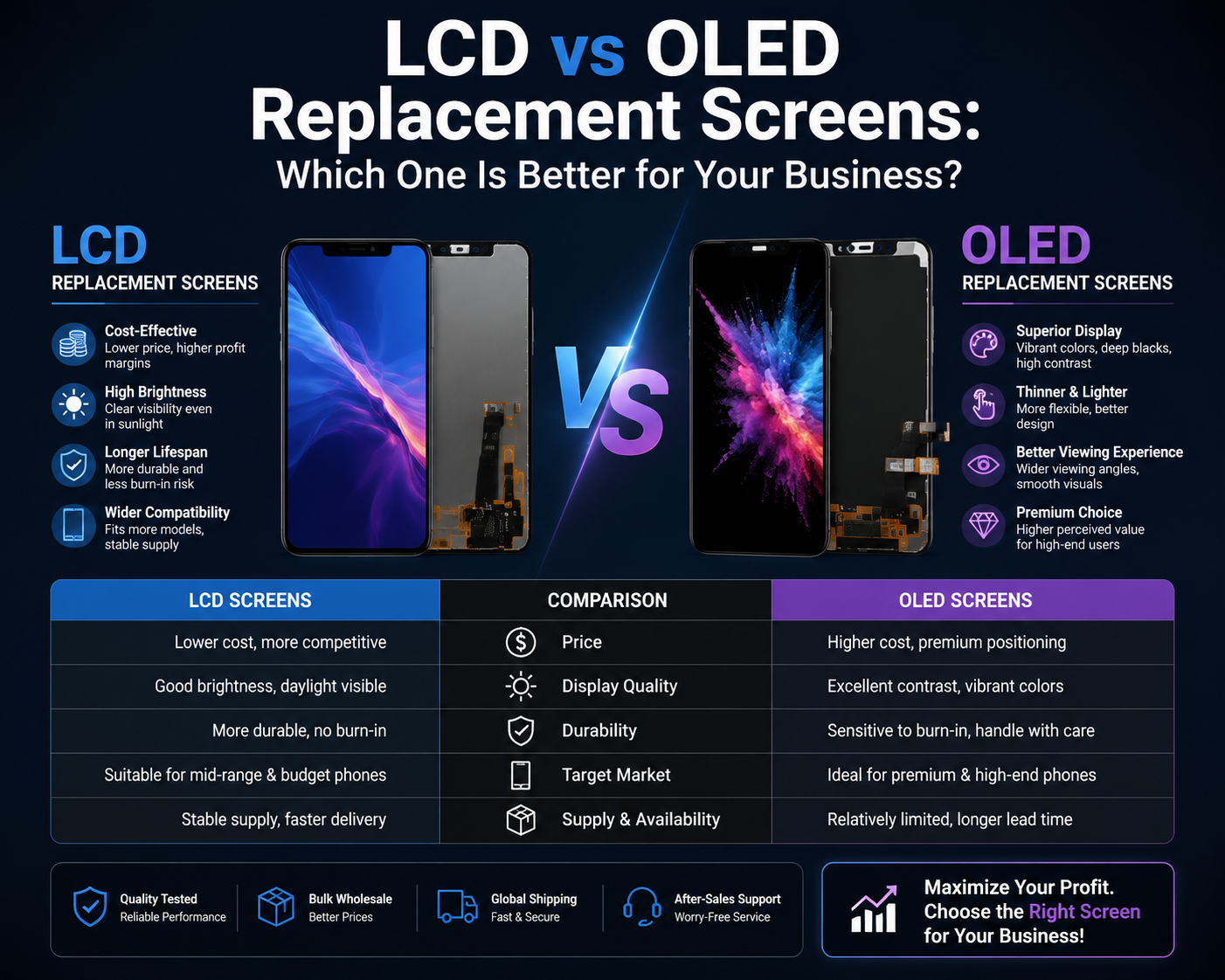
When sourcing smartphone display replacement parts, businesses often need to choose between LCD and OLED screens. For distributors and repair businesses, this decision directly affects product pricing, repair quality, customer satisfaction, and profit margins.
Both LCD and OLED replacement screens have their own advantages, and the right choice depends on your target market, phone models, customer expectations, and budget requirements. A phone repair display solution that works perfectly for one market may not be ideal for another.
This guide compares LCD vs OLED replacement screens to help businesses make better purchasing decisions — whether you are a high-volume repair chain, a wholesale distributor, or a phone refurbishment company looking for the right replacement screen comparison before placing bulk orders.
Understanding LCD and OLED Replacement Screens
Before diving into the replacement screen comparison, it is important to understand how each display technology works and where it fits in the mobile phone replacement screens market.
What Is an LCD Replacement Screen?
LCD (Liquid Crystal Display) technology uses a backlight to illuminate pixels. It is one of the most mature display manufacturing processes and is widely used in smartphones worldwide.
Key characteristics of LCD replacement screens:
- Uses backlight technology to produce images
- Mature manufacturing process with stable supply chains
- Widely used in mid-range and budget smartphones
Advantages for repair businesses:
- Lower cost per unit — ideal for price-sensitive markets
- Stable supply availability from LCD replacement screen suppliers
- Suitable for budget repairs where cost efficiency matters most
LCD screens are commonly applied in mid-range smartphones and cost-sensitive repair markets. For example, products like the Redmi Note 12 LCD display assembly and OPPO A7x LCD screen are popular choices for wholesale buyers.
What Is an OLED Replacement Screen?
OLED (Organic Light-Emitting Diode) technology uses self-emitting pixels that produce their own light, eliminating the need for a traditional backlight. This results in deeper blacks, higher contrast, and thinner display designs.
Key characteristics of OLED replacement screens:
- Self-emitting pixels — each pixel generates its own light
- No traditional backlight required
- Higher contrast ratio and better color performance
Advantages for premium repair markets:
- Deep blacks and excellent visual quality
- Better color performance and wider viewing angles
- Thinner design — matches premium smartphone aesthetics
OLED screens are typically used in flagship smartphones and high-end repair markets. Popular OLED replacement options include the OnePlus 8T AMOLED display assembly and OPPO Reno5 OLED display assembly.
LCD vs OLED Replacement Screens: Key Differences
When comparing LCD vs OLED replacement screens, several technical and commercial factors come into play. The table below summarizes the core differences that matter most to wholesale buyers and repair businesses:
| Feature | LCD Replacement Screen | OLED Replacement Screen |
|---|---|---|
| Display Technology | Backlit display | Self-emitting pixels |
| Image Contrast | Good | Excellent |
| Color Performance | Standard | Higher |
| Thickness | Usually thicker | Thinner |
| Cost | More affordable | Higher |
| Market Position | Budget repair | Premium repair |
Cost Comparison for Wholesale Buyers
For B2B buyers sourcing wholesale phone screens, cost is not just about unit price — it is about the balance between purchase cost, profit margin, and market demand. Understanding this balance is essential when choosing between an LCD replacement screen supplier and an OLED replacement screen supplier.
LCD Advantages for Wholesale Business
LCD screens are particularly well-suited for businesses focused on large-volume orders and price-sensitive markets. As a mobile phone parts supplier serving high-volume repair chains, LCD products offer distinct commercial advantages:
- Lower purchase cost — reduces overall inventory investment
- Easier inventory management — wider model availability and faster turnover
- Wider availability — multiple suppliers stock popular LCD models
- Fast-moving repair parts — high demand in budget repair markets
For distributors handling bulk mobile phone screens, LCD products such as the Xiaomi K40/Poco F4 LCD assembly and Vivo V20 LCD touch screen assembly represent reliable, high-demand inventory.
OLED Advantages for Premium Markets
OLED screens cater to a different segment — businesses servicing flagship smartphones and premium customers who expect original-level display quality.
- Better user experience — superior contrast and color reproduction
- Higher selling price — premium repairs command higher service fees
- Matches original display experience — important for flagship phone repairs
Premium OLED options like the OnePlus Nord 3 AMOLED assembly and Huawei Nova 10se OLED screen serve high-end repair markets where display quality is the top priority.
Which Replacement Screen Should Repair Businesses Choose?
The answer depends on your customer base and business model. Here is a breakdown by business type to help you make the right replacement screen comparison for your specific situation:
For High-Volume Repair Markets
Recommended: LCD replacement screens
High-volume repair markets prioritize affordability and fast turnaround. LCD screens are affordable, easy to sell, and see consistently large demand. For repair chains handling dozens of repairs daily, LCD products like the Vivo Y200 LCD assembly and OPPO A92s LCD screen offer the best balance of cost and quality.
For Premium Smartphone Repairs
Recommended: OLED replacement screens
Businesses servicing flagship devices need displays that match the original visual performance. OLED provides better contrast, deeper blacks, and a thinner profile — essential for premium smartphone repairs where customers expect original-level quality.
For Distributors
Recommended: Both LCD and OLED product lines
Distributors serving multiple repair businesses should carry both LCD and OLED products to cover different customer needs. Stocking a diverse range — from affordable LCD options like the Xiaomi Redmi Note 10 Pro LCD to premium OLED options like the OPPO K12x OLED display — ensures you can serve every segment of the repair market.
Quality Factors to Consider When Buying LCD and OLED Screens
Regardless of which display technology you choose, certain quality factors are universal. Whether you are sourcing from an LCD replacement screen supplier or an OLED replacement screen supplier, these criteria determine whether your purchase will satisfy your customers.
Display Performance
Display quality is the most visible factor for end customers. Always verify:
- Resolution — must match the original screen specifications
- Brightness — sufficient for both indoor and outdoor use
- Color accuracy — consistent color reproduction across units
- Viewing angle — no color shift when viewed from different angles
Touch Performance
Touch responsiveness is equally critical for user satisfaction:
- Touch sensitivity — immediate response to finger input
- Multi-touch response — smooth handling of pinch, zoom, and swipe gestures
- Digitizer quality — accurate touch positioning without dead zones
Compatibility
Compatibility errors are one of the most costly issues in smartphone display replacement. Before placing bulk orders, confirm:
- Phone model — exact match with target device
- Screen size — correct dimensions for proper fit
- Connector type — compatible with device motherboard
- Assembly design — frame and flex cable match original specifications
STMAX provides replacement screens covering major brands including Huawei, OPPO, Vivo, Xiaomi, Redmi, and OnePlus. For example, the Huawei Mate60 LCD assembly and Xiaomi Mi11t LCD assembly are designed for precise model compatibility.
Supplier Quality Control
A reliable supplier should test every screen before shipment. Key testing procedures include:
- Display function testing — verifies image output, brightness, and color
- Touch function testing — confirms touch sensitivity and accuracy
- Appearance inspection — checks for scratches, dead pixels, and assembly defects
For more insights on supplier evaluation, read our guide on how to choose a reliable mobile phone replacement screen supplier and our wholesale mobile phone LCD screens buying guide.
Why Choosing the Right Display Supplier Matters
Screen procurement is not just about comparing prices. The wrong supplier can seriously damage your business through:
- High return rates — defective screens lead to customer returns and refunds
- Customer complaints — poor display quality hurts your reputation
- Lost repair business — unreliable supply causes delays and lost customers
A reliable supplier, on the other hand, provides consistent quality, stable supply, and technical support — the foundation of a sustainable repair or distribution business. To learn more about bulk purchasing strategies, see our article on LCD screen wholesale for distributors.
STMAX LCD Replacement Screen Solutions for Global Buyers
As a professional mobile phone replacement screen supplier, STMAX provides comprehensive display solutions for global distributors, repair businesses, and wholesale buyers:
- LCD replacement screens — cost-effective solutions for high-volume repair markets, including products like the Vivo V23 5G LCD assembly and OPPO Reno7 Pro LCD screen
- OLED replacement screens — premium display options for flagship repairs, including the OnePlus 7T AMOLED screen and OnePlus Nord OLED assembly
- Mobile phone display solutions — full product range covering LCD, OLED, and touch screen assemblies
STMAX supports major smartphone brands including Huawei, OPPO, Vivo, Xiaomi, Redmi, and OnePlus. Whether your business needs affordable LCD inventory for high-volume repairs or premium OLED screens for flagship customers, STMAX can provide the right phone repair display solutions for your market.
Explore our complete product catalog or learn more about STMAX and our display manufacturing capabilities.
Frequently Asked Questions
Q1: Are OLED replacement screens better than LCD screens?
OLED generally provides better image quality with deeper blacks and higher contrast, while LCD offers better cost efficiency for many repair applications. The right choice depends on your target market and budget requirements.
Q2: Which replacement screen is better for wholesale purchasing?
It depends on your target customers. LCD is suitable for high-volume, affordable repairs with fast turnover, while OLED fits premium smartphone repairs where display quality is the top priority. Many distributors stock both to cover different market segments.
Q3: Can suppliers provide both LCD and OLED replacement screens?
Yes. Many professional display suppliers, including STMAX, offer both LCD and OLED solutions to meet different market requirements. This allows distributors to source all their replacement screens from a single reliable supplier.
Q4: How can I verify replacement screen quality before bulk ordering?
Check display performance (resolution, brightness, color accuracy), touch response (sensitivity, multi-touch), compatibility with target phone models, the supplier's testing process, and their reputation in the industry. Always request samples before placing large orders.
Need reliable LCD and OLED replacement screens for your wholesale business?
STMAX provides professional mobile display solutions for global distributors and repair companies.
View Product Catalog Contact STMAX