

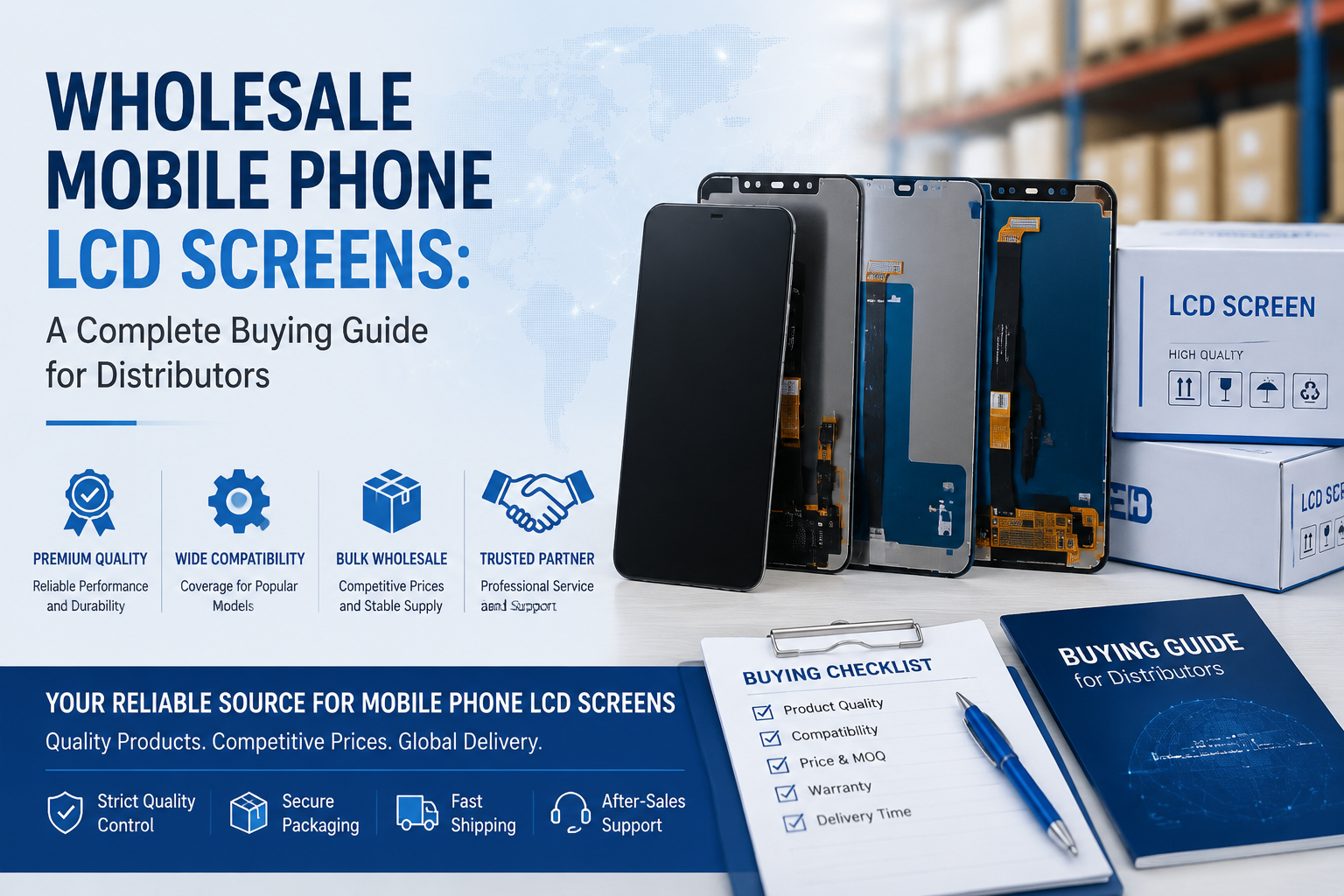
The global mobile phone repair market continues to expand, and an increasing number of repair businesses, parts distributors, and refurbishment companies need a stable supply of wholesale mobile phone LCD screens, touch screen assemblies, and smartphone display parts. However, bulk purchasing requires more than finding a low-price supplier. Distributors must carefully evaluate product quality, model compatibility, supply stability, and after-sales support to protect their margins and reputation. This guide explains what distributors should know before buying wholesale mobile phone LCD screens, from product types and quality standards to supplier selection and procurement risk management.
Why Businesses Buy Mobile Phone LCD Screens Wholesale
For repair shop chains, parts distributors, and mobile phone refurbishment companies, purchasing replacement screens at wholesale volume offers three core advantages over retail or small-quantity sourcing.
Lower Purchasing Cost
Wholesale pricing significantly reduces the per-unit cost of replacement screens. When you buy in volume, suppliers can offer tiered discounts that reflect manufacturing economies and reduced per-order handling overhead. Lower unit costs directly improve profit margins on every repair, giving your business a competitive edge in price-sensitive repair markets. For a detailed breakdown of wholesale economics, see our LCD screen wholesale guide for distributors.
Stable Product Availability
In the repair industry, stock availability is critical. When a customer walks in with a broken phone, they expect a same-day or next-day repair. Running out of screens for popular models causes:
- Repair delays: Customers may take their business to a competitor who has the part in stock.
- Customer complaints: Promised repair timelines that slip due to parts shortages damage your reputation and lead to negative reviews.
- Lost revenue: Every day a repair is delayed is a day the revenue from that repair is not collected.
Wholesale purchasing allows you to maintain buffer stock of your most-demanded models, ensuring consistent service availability even when supply chains experience disruptions.
Easier Inventory Management
Bulk purchasing streamlines inventory management by reducing the frequency of orders, simplifying supplier communication, and enabling predictable restocking cycles. Distributors can plan regional allocation, stock popular models strategically, and forecast demand based on volume purchase patterns rather than reactive, one-at-a-time ordering. For broader market context, read our guide to mobile display assembly solutions.
What Types of Mobile Phone LCD Screens Can Be Purchased Wholesale?
Understanding the different screen types available for wholesale purchase helps distributors match their inventory to market demand and price points. STMAX offers three primary categories of replacement screens for wholesale buyers.
LCD Screen Replacement
LCD screen replacements are the backbone of the mobile phone repair market. They are used to repair devices with cracked screens, display damage (such as dead pixels, lines, or backlight failure), and touch failure. LCD replacements are cost-effective and widely used across virtually every phone brand and model. For a comprehensive overview, see our LCD screen replacement guide for smartphones and devices.
LCD Touch Screen Assembly
An LCD touch screen assembly combines the LCD display panel and touch digitizer into a single pre-assembled unit with a frame. This integrated solution offers several advantages for repair businesses:
- Easier installation: Technicians replace the entire frame assembly rather than separating and rebonding individual layers, reducing labor time and skill requirements.
- Better compatibility: Factory-assembled units eliminate alignment issues that can occur with manual digitizer bonding.
- Reduced repair time: Faster turnaround means more repairs per day and higher customer throughput.
See our Redmi Note 12 LCD with touch digitizer full assembly or Vivo V20 LCD touch screen assembly as product examples. For technical background, read our LCD touch screen technology guide.
OLED Replacement Screens
OLED replacement screens offer higher contrast, deeper blacks, and better color performance compared to LCD. They are the premium replacement option for high-end phone models that originally shipped with OLED or AMOLED displays. Replacing an OLED screen with an LCD alternative results in a visible quality downgrade that end users often notice. For premium repair markets, OLED replacements maintain the original display experience. See our OnePlus 8T AMOLED display assembly and OPPO Reno5 OLED display assembly for examples.
Key Factors to Consider When Buying Wholesale Mobile Phone LCD Screens
When purchasing wholesale mobile phone LCD screens, distributors must evaluate several critical factors that determine whether the screens will meet their customers' expectations and protect their business from quality-related losses.
Compatibility With Different Phone Models
Compatibility is the first and most fundamental consideration. A replacement screen that does not perfectly match the target device causes installation problems and return costs. Before placing a wholesale order, confirm:
- Brand compatibility: Ensure the supplier covers the brands your market demands — Huawei, OPPO, Vivo, Xiaomi, Redmi, and OnePlus are the most commonly repaired. See our products for Huawei Mate 60, OPPO Reno7 Pro, and Xiaomi Mi 11T.
- Model number: Even within the same brand, different model numbers may use different screen specifications. Verify exact model compatibility before ordering in bulk.
- Screen specifications: Resolution, connector type, frame design, and touch controller must all match the original device.
Wrong compatibility causes installation problems and return costs that quickly erase any savings from a lower unit price. For model-specific guidance, explore our full product catalog.
Screen Quality and Performance
Quality directly impacts customer satisfaction and warranty return rates. Every wholesale batch should be evaluated across three performance dimensions:
Display Performance:
- Brightness: Replacement screens should match OEM brightness levels. Dim screens signal inferior backlight quality.
- Color accuracy: Color temperature and saturation should match the original display without visible shifts.
- Resolution: The panel must deliver the full native resolution of the original screen.
- Viewing angle: Colors and brightness should remain consistent at off-axis viewing angles.
Touch Performance:
- Touch sensitivity: The digitizer must respond accurately across the entire screen surface.
- Multi-touch response: Multi-finger gestures should register without lag or missed inputs.
Physical Quality:
- Glass durability: Cover glass should resist scratches and impacts at a level comparable to OEM standards.
- Assembly quality: Frame alignment, adhesive application, and connector fit must be precise to ensure proper installation.
For more on quality evaluation, read our phone display parts guide.
Quality Control Before Shipment
A reliable mobile phone parts supplier should perform systematic pre-shipment testing on every unit or at minimum on a statistically significant sample. The testing protocol should include:
- Function testing: Power-on verification to confirm the display initializes correctly and the backlight functions.
- Display testing: Visual inspection for dead pixels, light leakage, color uniformity, and brightness consistency.
- Touch testing: Digitizer calibration verification across the full screen area, including edge and corner sensitivity.
- Appearance inspection: Check for scratches, dust particles, frame defects, and connector damage.
Rigorous pre-shipment testing significantly reduces the defective rate and the customer complaints that follow. For insights into manufacturing quality standards, see our article on OEM LCD screen quality and manufacturing.
Packaging and Shipping Protection
Mobile phone LCD screens are fragile products that can be damaged during transit if not properly packaged. A responsible mobile phone LCD screen supplier should provide:
- Protective packaging: Each screen should be individually packaged with foam or bubble padding to absorb shock and prevent pressure damage to the glass.
- Anti-static protection: Anti-static bags protect the sensitive LCD driver IC and touch controller from electrostatic discharge during shipping.
- Safe transportation solutions: Bulk orders should be packed in sturdy cartons with internal dividers to prevent screen-to-screen contact and distribute weight evenly.
Inadequate packaging leads to transit damage that may not be visible until installation, resulting in unexpected defective rates and disputes with the supplier. For more on component handling, read our LCD assembly components guide.
How to Choose a Reliable Wholesale Phone Screen Supplier
Selecting the right wholesale supplier is the single most impactful procurement decision a distributor can make. The following criteria help separate dependable suppliers from unreliable ones.
Manufacturing Experience
A supplier's manufacturing experience directly correlates with product consistency and problem-solving capability. Evaluate:
- Industry experience: How long has the supplier been manufacturing mobile phone display modules? Experienced manufacturers have refined their production processes and quality control systems.
- Product range: A broad product range indicates deep market understanding and the ability to support multiple brands and models from a single source. Explore our product range for reference.
- Production capability: Can the supplier handle your volume requirements, including peak-season surges? Ask about monthly capacity and lead times for repeat orders.
For context on manufacturing capabilities, read about full-chain production and display quality at STMAX.
Product Availability
A supplier's stock position directly affects your ability to serve customers without delays. Key questions to ask:
- Popular models stock: Does the supplier maintain ready stock of your most-demanded models, or is everything made-to-order? Ready stock enables 1-3 day shipping, while make-to-order typically requires 7-15 days.
- Fast replenishment: How quickly can the supplier restock a model that sells out? Suppliers with their own manufacturing lines can replenish faster than trading companies that depend on upstream sources.
Communication and Support
Ongoing communication and support differentiate a true supply partner from a one-time vendor:
- Technical support: Can the supplier provide installation guidance, compatibility confirmation, and troubleshooting assistance when issues arise?
- Order tracking: Does the supplier provide proactive order status updates and shipping tracking information?
- After-sales service: What is the warranty policy for defective units? A supplier that stands behind its products with clear warranty terms is a safer long-term partner.
For more on supplier evaluation criteria, read our article on choosing a reliable mobile phone replacement screen supplier.
Wholesale Mobile Phone LCD Screens vs Retail Purchasing
For businesses that need screens on an ongoing basis, the choice between wholesale and retail purchasing has significant implications for cost, reliability, and scalability.
| Factor | Wholesale Supplier | Retail Purchase |
|---|---|---|
| Price | Lower per-unit cost with volume discounts | Higher per-unit cost with retail markup |
| Product Range | Wide range of models and brands | Limited to available retail stock |
| Supply Stability | Consistent supply with scheduled deliveries | Unstable, subject to retail availability |
| Business Growth | Suitable for scaling operations | Not suitable for business scaling |
For distributors and repair businesses processing more than a handful of repairs per week, wholesale purchasing is the clear choice. For more on the broader smartphone display market, see our smartphone display screen guide.
Why Choose STMAX for Wholesale Mobile Phone Screens
STMAX is a professional display manufacturer providing wholesale mobile phone LCD screens and related replacement solutions to global distributors, repair chains, and refurbishment companies. Our wholesale product portfolio includes:
- Mobile phone LCD replacement screens: High-quality LCD assemblies for Huawei, OPPO, Vivo, Xiaomi, Redmi, and OnePlus. See our Huawei Nova 7 screen assembly and Xiaomi Mi 11 Lite display replacement.
- Touch screen assemblies: Pre-assembled LCD and digitizer modules for fast, reliable repairs. See our Poco F4 / K40 LCD touch assembly and OPPO Reno 8 LCD touch assembly.
- OLED replacement solutions: Premium OLED and AMOLED assemblies for high-end device repairs. See our Huawei Nova 10SE OLED replacement and OnePlus Nord 3 AMOLED assembly.
We support all major brands including Huawei, OPPO, Vivo, Xiaomi, Redmi, and OnePlus, with continuous model updates to match the latest device releases. Our commitment to wholesale partners includes:
- Wholesale supply: Volume-based pricing and flexible MOQs for distributors and repair businesses of all sizes.
- Consistent quality: Every screen undergoes function, display, touch, and appearance testing before shipment.
- Multiple phone models: A growing catalog covering hundreds of phone models across six major brands.
- Professional display manufacturing experience: Direct factory production with established quality control processes. Learn more about STMAX.
Frequently Asked Questions
What should I consider when buying wholesale mobile phone LCD screens?
Key factors include compatibility with your target phone models, screen quality (brightness, color accuracy, touch sensitivity, glass durability), supplier reliability (manufacturing experience, stock availability, after-sales support), pricing (volume discounts, payment terms), and delivery (lead time, packaging quality, shipping methods). Evaluating all these factors together helps minimize procurement risk and ensures consistent quality for your customers.
Can I buy replacement phone screens in bulk from manufacturers?
Yes. Many manufacturers, including STMAX, provide wholesale supply directly to distributors and repair businesses. Buying directly from a manufacturer offers better pricing, stricter quality control, more stable supply, and direct technical support compared to purchasing through intermediaries. Contact the manufacturer with your model list and expected volume to receive a wholesale quotation.
What is the difference between LCD replacement screens and OLED screens?
LCD replacement screens use a backlight to illuminate the display and are affordable, widely compatible, and suitable for the majority of phone repair scenarios. OLED screens are self-emissive — each pixel produces its own light — which delivers better contrast, deeper blacks, and more vibrant colors. OLED is the premium replacement option for high-end phones that originally shipped with OLED displays. For more detail, read our cell phone screen technology guide.
Which phone brands are available for wholesale replacement screens?
STMAX provides wholesale replacement screens for Huawei, OPPO, Vivo, Xiaomi, Redmi, and OnePlus. Our catalog covers popular models from budget to flagship across these brands, with new models added regularly. Browse our product catalog for the full model list, or contact us with specific model requests.
Looking for a reliable wholesale mobile phone LCD screen supplier?
STMAX provides high-quality replacement displays and touch screen assemblies for global distributors and repair businesses.
Contact Us View ProductsSTMAX | Wholesale Mobile Phone LCD Screens | Global Display Supplier